
Howdy, Stranger!
It looks like you're new here. If you want to get involved, click one of these buttons!
Quick Links
Categories
Supported by

It looks like you're new here. If you want to get involved, click one of these buttons!

Comments
Hi GE,
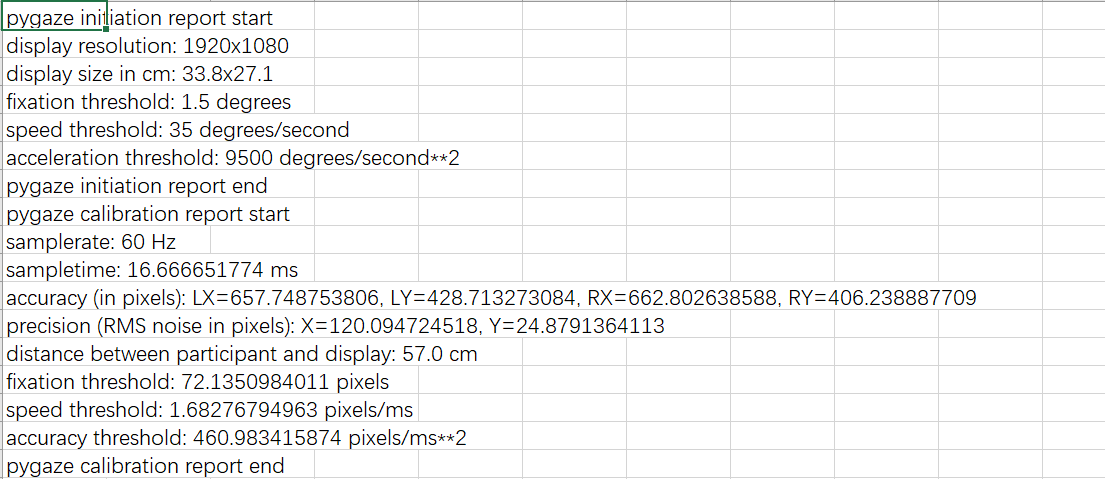
The accuracy is computed during the validation, and it is the average absolute distance between point-of-regard samples and a visible target.
The precision is computed during the noise calibration, and it is the horizontal and vertical root mean square of consecutive samples.
The values are in pixels because that's how they are computed. If you want to know what that means in the more common unit of "degrees of visual angle", you'd have to know the screen dimensions in centimeters, as well as the distance between the participant's eye and the screen in centimeters. (Note that these values are included in the report, but they are based on the user-defined values of
SCREENSIZEandSCREENDIST, and hence are only accurate if you defined them accurately.)Cheers,
Edwin