

How to compute Standard Error for effect size from confidence intervals?

Hi All!,
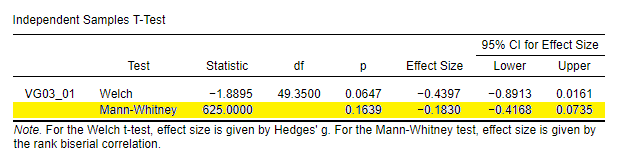
I want to perform a meta analysis of the non-parametrical effect sizes (two independent samples comparison). From JASP I can easily get the non-parametrical effect size - It provides me with rank biserial corellation and confidence intervals.
BUT, to do a classical meta-analysis in JASP I need effect size and SE. So I tried to manually compute SE from effect size and lower/upper CI, but the standard formulas doesn't seem to work. I tried this one : Upper CI - Lower CI/3.92, but something is wrong. When I compute SE like this and do a meta, I get a slightly different CI bounds, that I got in the original JASP output. Eg. - look at the study 6 and its CI:

And originally, study 6 had an effect like this one :
The CI's are clearly not the same! (although pretty close)
So summing up - how can I get from CI bounds to SE for the rank biserial correlation or otherwise, how can I go around this issue and do a meta-analysis, given infos provided in such tables?
Any clues appreciated ! :),
Cheers,
Kamil
Comments
Hi Kamil,
sorry for the late reply.
I think that the issue here is two-fold.
First, correlation coefficients do not have symmetrical confidence intervals (unless the effect size is 0). When you pass the confidence intervals into the input of the meta-analysis module, it needs to convert it into the standard errors, which are used to estimate the models. It has no other choice than to assume that the confidence interval is symmetrical and it computes the standard error based on its width. Later, when it generates the forest plot, it uses the same information that it used for estimating the model - the effect sizes and standard errors (obtained from the confidence intervals), and it creates symmetrical confidence intervals based on the data.
Second, it is usually not a good idea to perform a meta-analysis on correlation coefficients directly. The correlation coefficients are bounded to -1, 1 interval, and their standard errors are dependent on the effect size value. The usual solution to this is to perform a Fisher's z transformation - it "unwinds" the scale to be from -Inf to Inf and stabilizes the standard errors in a way that they depend only on the sample sizes.
Currently, we do not support a Fisher's z transformation directly within the meta-analysis module (unless you want to try out the Robust Bayesian meta-analysis that supports correlation and sample sizes directly as input + automatically transforms the input on the background and produces output transformed back to correlation coefficients). However, you can manually add a new column in the JASP data editor:
and transform your correlations into Fisher's z
You can then compute the standard errors as:
1/sqrt(N-3)
where N is the sample size. More about here: https://en.wikipedia.org/wiki/Fisher_transformation.
Unfortunately, that will make all your input to be on Fisher's z scale and you will have to transform it back to correlation coefficients manually.
I am aware that it is not the ideal solution and we are working on implementing a more user-friendly and automatic way of dealing with correlation coefficients into the interface, but it will take a bit more time and it won't be in the next release.
Cheers,
Frantisek
Thank you very much!
I will try both of these solutions, and if you are working on some improvements to JASP, I think that option of adding a Standard Error to all tables will be a great feature! Right now its all just CI's, which is usually good enough, but if adding SE is not a big effort, it will make some statistical work at least one step shorter.
Cheers,
Kamil
Could you use: SQRT((1-rsquared)/(n-2))
FYI - My response above will not work. Apologies.