

Infinity symbol in BF inclusion + covariates

Dear all,
I have two questions regarding the bayesian version of the repeated measures ANOVA. So first I run the ANOVA with two between and two within-subject factors.
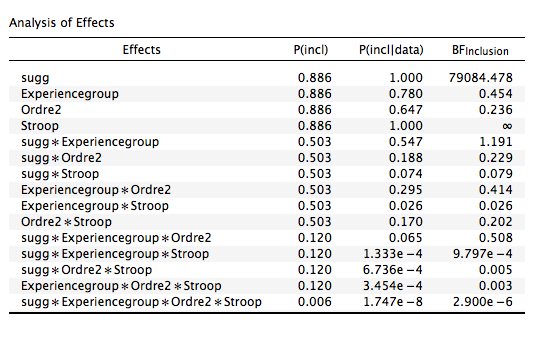
1) When I run this ANOVA, unexpectedly, I obtained an infinity symbol instead of a number in the column for BF inclusion, see screenshot below. I never had that before and I have no idea about what to do with this (and how to get a number instead to report in the paper).
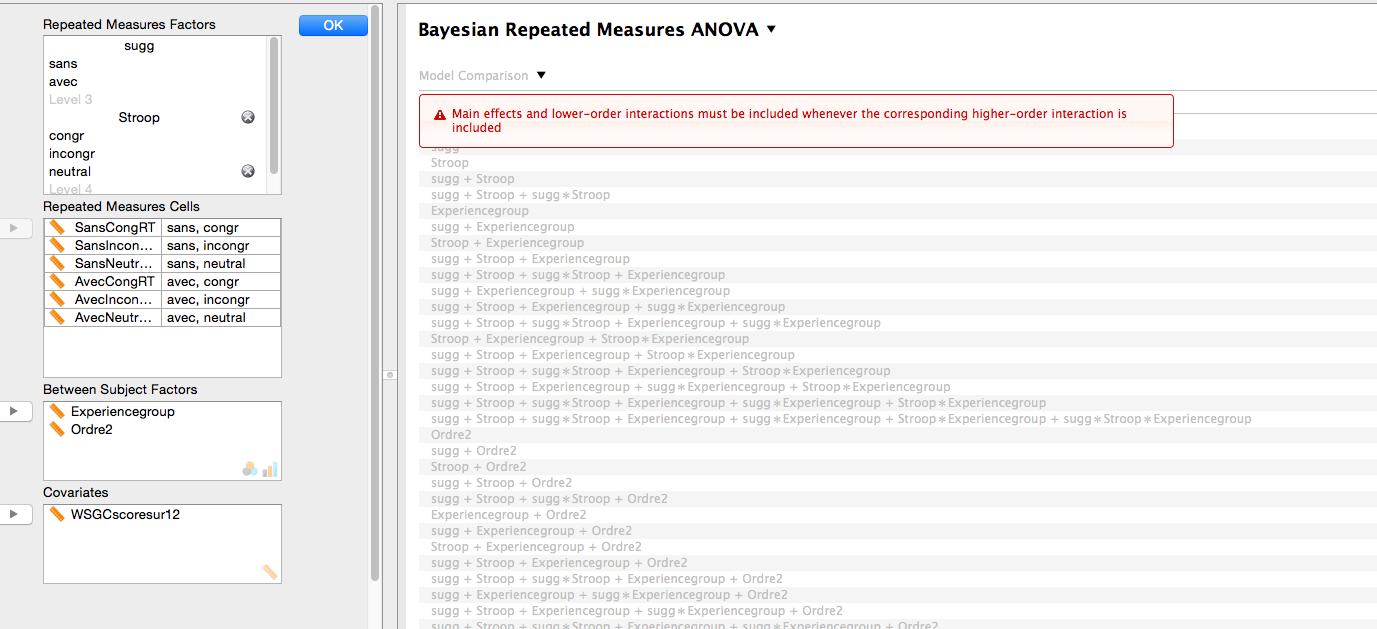
2) Then I try to introduce a covariate in the same ANOVA and I get the following error message: "Main effects and lower-order interactions must be included whenever the corresponding high-order interaction is included" (see second screen shot below). With the frequentist ANOVA it works, so I don't know why with BF it doesn't.
Thank you for the help!
Emilie
Comments
Hi Emilie,
Re. 1) You can see from the table that the summed posterior probability for the models that include the factor of interest is "1.000". In reality, that is not exactly true -- there must remain some sliver of posterior probability for the models that exclude that factor. However, this sliver is so small that it exceeds the numerical capacity of R. So the "1.000" is rounded upwards from 0.99999999999 etc. This cause the "infinity" symbol. So you can say that the evidence is so large that it exceeds the numerical precision of your computer. (as an aside, I will check that the inclusion probabilities are not computed based on the rounded values -- that would be bad).
Re. 2) The Bayesian models respect the principle of marginality, which means that when an interaction is included, the constituent main effects need to be included as well. This makes a lot of sense for several reasons. If you want to know more go to https://link.springer.com/article/10.3758/s13423-017-1323-7 and search for "marginality".
Cheers,
E.J.
Hi, I'm aware I'm posting on an old thread but I also have a question about when the infinity symbol appears for the BF10 factor. Specifically, I wonder how, in that case, one calculates the BF10 for an interaction. I would usually divide the BF10 (model with interaction) by BF10 (model without interaction). But if both models have a BF10 of infinity, I am unsure how to calculate BF10 for the interaction (infinity divided by infinity?). I wonder if anyone could advise. Thanks!
In that case I'd add the main effects to the null model as nuisance factors, so they are always included (under "model").