Error during ANOVA

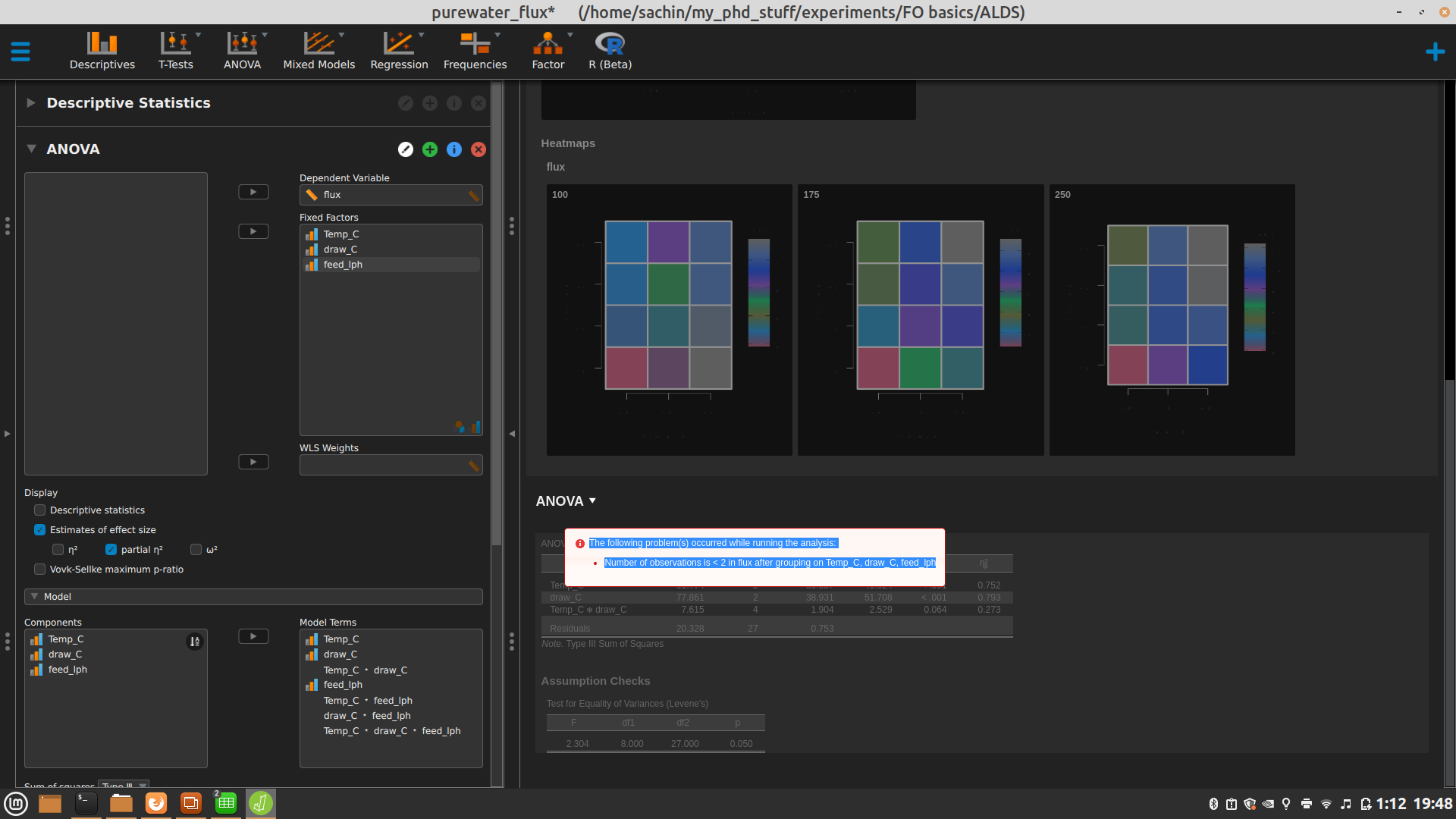
The observed error can be seen in the screenshot. Any work around?

It looks like you're new here. If you want to get involved, click one of these buttons!

The observed error can be seen in the screenshot. Any work around?
Comments
It is apparently a matter of sample size. It seems you are running a 3-way ANOVA with "Temp", "Raw," and "Feed" as grouping variables. Each grouping variable must have at least two categories (or levels) to be compared. The ANOVA will compare the main effects (each single grouping variable) and the interactions (one grouping variable depending on another grouping variable). For the interaction, the sample size will break down into subgroups (combinations between categories of grouping variables). For instance, if "Temp," "Raw," and "Feed" grouping variables have two categories each, you will have eight subgroups (2 x 2 x 2). If your n=40 and we assume an even distribution, you may expect to have n=5 per subgroup (40/8). In your case, at least one subgroup has n<2 (could be either n=1 or n=0). A frequency table with the split function may help determine the problem.
I hope this helps.
Alejandro.