

Repeated Measures Bayesian ANOVA

Hello!
I enjoyed your Bayes JASP workshop last year very much, thank you again for presenting this interesting approach. Since last year I am trying to use JASP and report Bayes factors in my papers as well.
I conducted a bayesian repeated measures ANOVA, but am insecure how to report it properly.
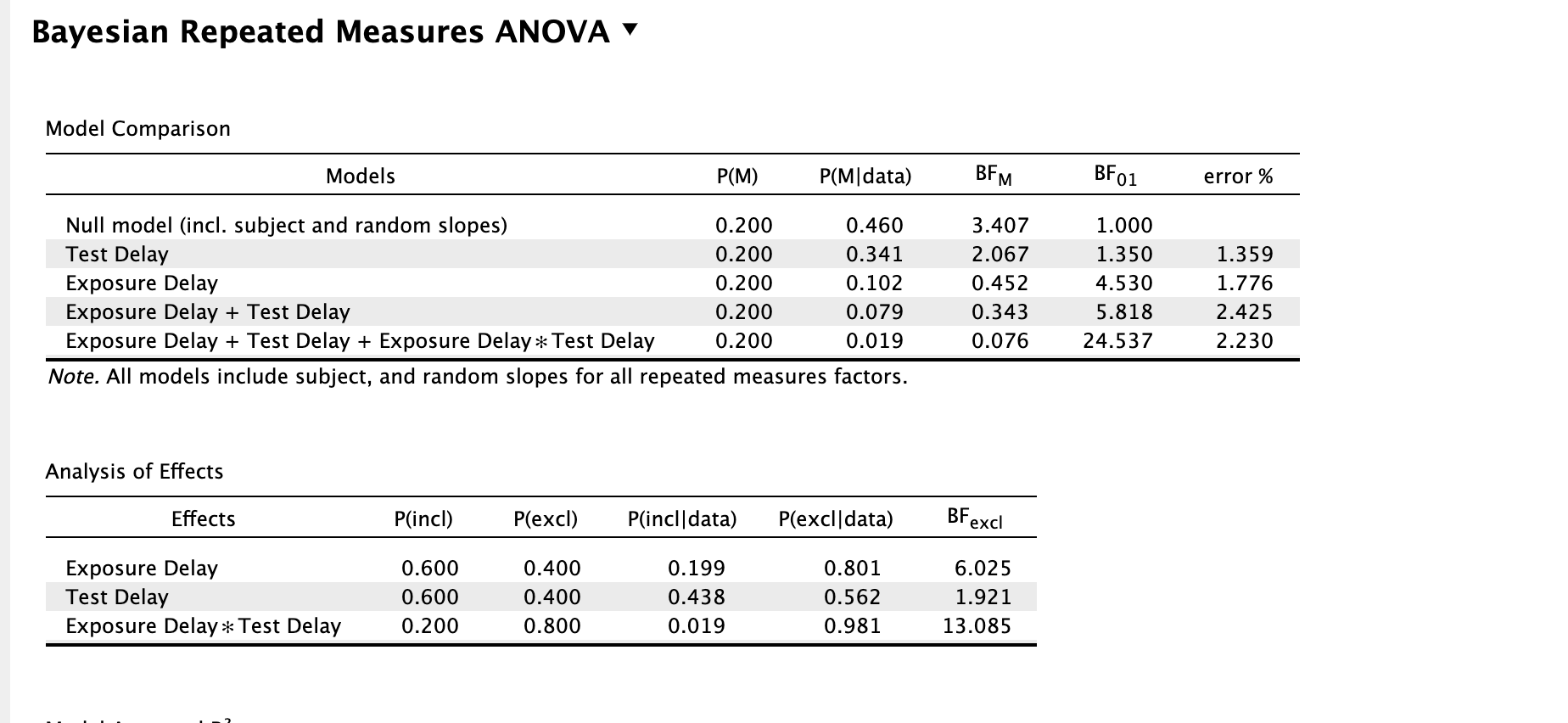
As a classical ANOVA showed evidence for the Null hypothesis, I calculated the BF01 accordingly (compare to best model). The Null Model seems to be fitting best here (see attached file).
However, I read in an article Keysers et al. (2020) that a BF around 1 means there is no evidence at al.
"If the Bayes factor calculated as ℒgroup/ℒnullis >1, there is evidence for the effect of group. If BF < 1, i.e., the null model outperforms the more complex group model, there is evidence for the absence of an effect of group. If BF ≈ 1 we have absence of evidence. This Bayes factor can be interpreted using the same bounds discussed in Fig. 2 and Extended Data Fig. 1."
As the Bayes Factor B01 is 1.000 in my analysis, is there no interpretation at all possible, neither for H0 nor for H1? I am simply not sure how to report this finding exactly in my paper. This would be my approach:
To ensure that our null hypothesis did not arise by chance, we performed a Bayesian repeated measure in favor of the null hypothesis. We found strong evidence in favor of the null hypothesis, as the null model was the best fitiing model (BF01 = 1.000).
Thank you so much!
Comments
Dear CCtt,
The first entry compares the model against itself, so it is always 1.00. Looking at the table quickly, it seems you have some evidence for the null -- highly ambiguous in the case of Test Delay, but more impressive for the other factors.
Also, note that we recently proposed a different default for repeated measures ANOVA. For details see this blogpost (and a reference to a preprint): https://jasp-stats.org/2022/07/29/bayesian-repeated-measures-anova-an-updated-methodology-implemented-in-jasp/
Cheers,
E.J.
Thank you EJ!
I did not know about the blogpost, really interesting in terms of analyzing