
Planned contrast & one-sided t-test

Hi all,
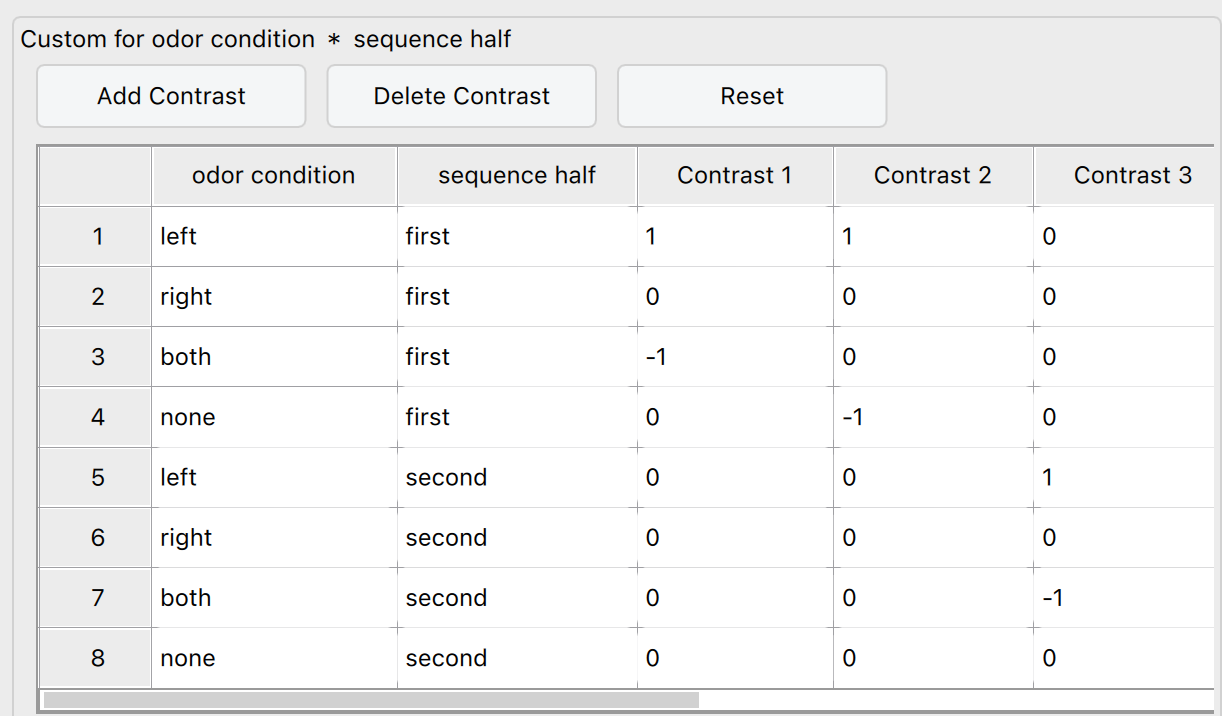
I would like to conduct planned contrasts, following a RM-ANOVA. Is there any way to account for the expected direction of the effects (i.e., analogous to conducting a one-sided t-test)? I specified custom contrasts, by setting one factor of interest to -1 and the other to 1 (see attached image). For instance, I specifically expect a decrease in my DV for odor-left (first half) vs. odor-both (first half) trials. In that case, does it matter for which of the factors I assign a "1" vs. "-1", if I want to compute a one-sided t-test?
I appreciate any help with this issue.
Kind regards,
Laura
Comments
Hi Laura,
Sorry about the delay. I've forwarded this to our expert. I will note that the "Order Restricted Hypotheses" is something you might want to check out.
Cheers,
E.J.
Hi @laiskl ,
The contrast analyses are only available as two-sided tests for now. The contrast weights determine whether you compute A-B or B-A, which in the case of a two-sided t-test leads to the same results. You could manually take the two-sided p-value and convert it to a one-sided p-value by checking whether the difference in means is in line with your one-sided alternative hypothesis, and then dividing the p-value by 2 if that is the case.
For instance, if you have a single contrast analysis between two groups A and B, with HA positing that A is greater than B, and you observe, for the contrast A-B:
Mean difference = 2, t = 2.5, p-value = 0.20
This is in line with the one-sided alternative hypothesis (A greater than B, so A - B is posiitve), so to convert to a one-sided p-value you can take 0.2 / 2 = 0.1.
As EJ suggests, you might also want to look at the order restricted hypothesis tests.
Kind regards,
Johnny