


Error term in contrasts

Hi,
How does JASP select the error term it uses to calculate contrasts (planned or post hoc)?
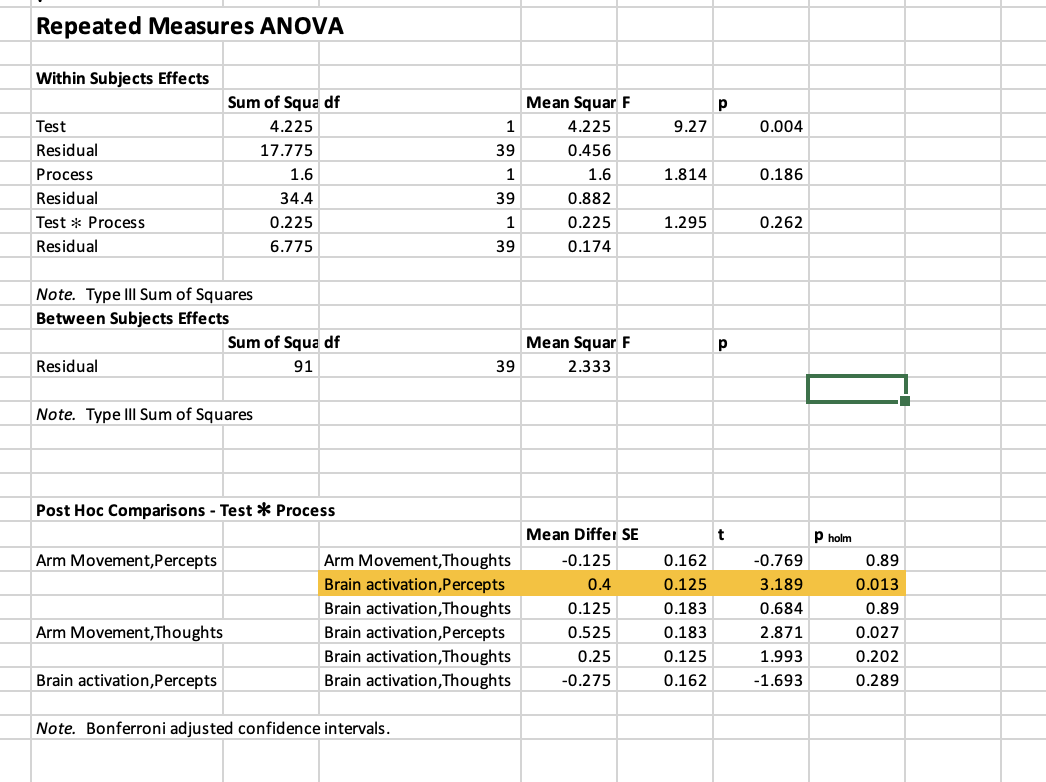
Suppose, for example, you have a 2x2 fully repeated measures ANOVA. Many softwares (e.g., SPSS, Statistica) use the MSE term from the interaction in the ANOVA (in the example attached, that would be .174). Accordingly, all contrasts that form part of the interaction are tested using the same error term. This, however, is not the case in JASP, as the SE that is reported varies for different contrasts.
How does JASP calculate the error term?
thanks
Iris
Comments
Hi Iris,
In the RM ANOVA, this depends on which setting is used for the "assume equal variances" option. By default this is turned on, and JASP uses the default behavior of the R package that is under the hood in JASP - emmeans. If the option is deselected (which only works for main effects), JASP basically performs a series of paired samples t-tests.
Each contrast has different terms in it. For instance, the "simple" contrast compares one level to another level, whereas the Helmert contrast compares each level to multiple other levels. The number of levels here affects the standard error. So even though the standard deviation of the mean difference is assumed to be the same, the different numbers of levels under comparison differs and leads to dissimilar standard errors.
Does this help? If not, do you have a specific data set that I can look at, in order to explain it more concretely?
Kind regards,
Johnny