


Bayesian Reapeated Measures JASP

Hey everyone,
I am working on my master thesis at the moment and I was given a manuscript specifiying which analyses I have to do. I have to perform (amongst others) a 3 × 2 [stimulation condition × stimulus type] within-subjects analyses of variance with Bayes factors. I decided to work with JASP for this. However, I have neither done Bayesian analyses before nor have I worked with JASP before. That is why I am really unsure whether it is correct what I did and how to interpret it. This is my output:
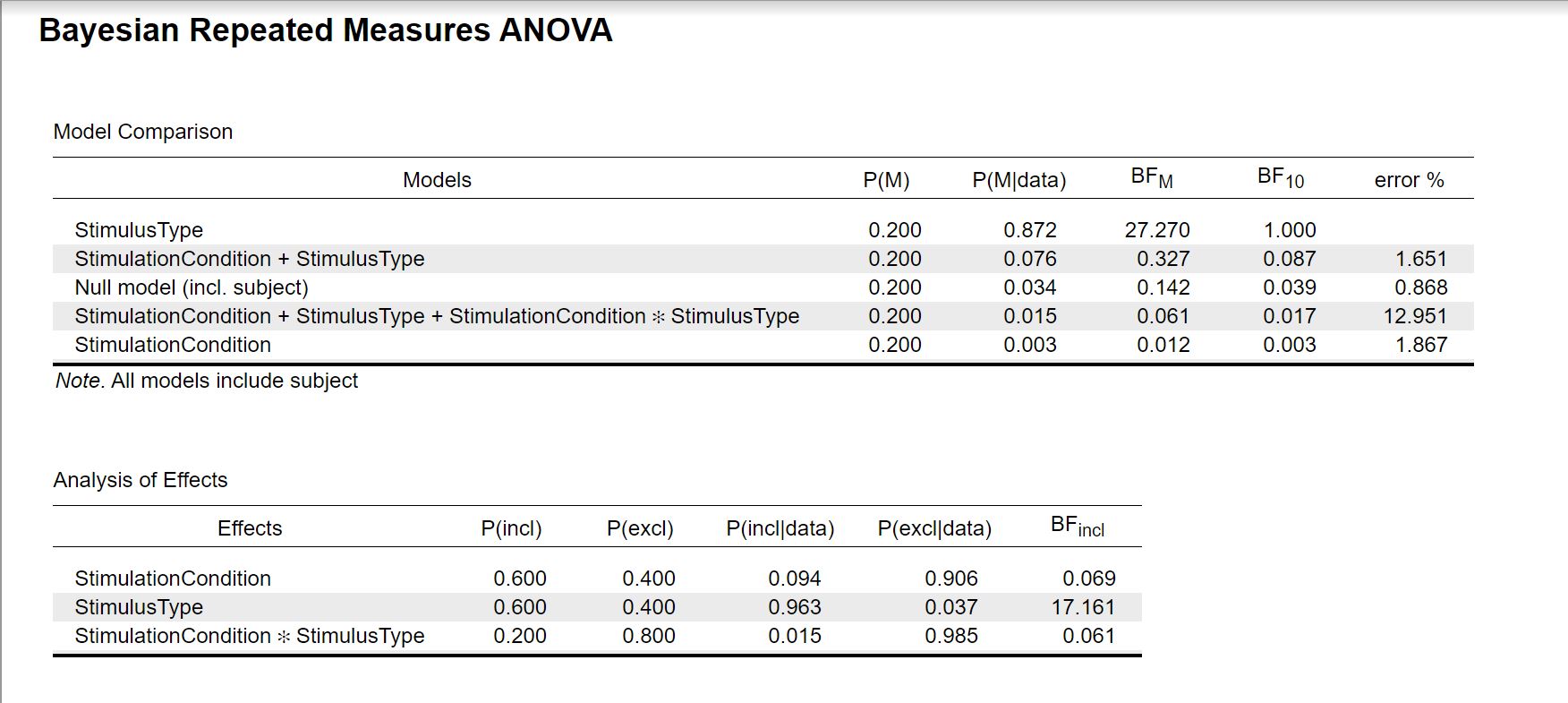
My alternative hypothesis is that the dependent variable will be lower in one of the three different conditions for one specific stimulus type. For the other stimulus type it is open as what the effect will be.
The manuscript further specifies that a bayes factor of > 3 indicates moderate evidence for the alternative hypothesis, and bayes factor < 1/3 indicates moderate evidence for the null hypothesis.
I have read through many articles on how to interpret the output. I am really confused though, for example why is BF10 for stimulus type 1.000? What exactly does that mean?
Thank you all very much in advance, I am really glad that I have found this helpful forum here!
Best,
Soph
Comments
Hi Soph, I'm relatively new to using Bayesian stats myself, and I found this to be the most helpful guide: https://jasp-stats.org/2020/05/19/bayesian-inference-in-jasp-a-new-guide-for-students/ It's not up-to-date for the current version of JASP but will probably be able to address most of your questions.
Regarding your specific question about the BF for stimulus type being 1, this is because the radio button under Order is set to "Compare to best model", meaning the top model is the best and will always have a BF of 1, and the rest of the BF will be smaller in order of their comparison to the best model. You technically could use this to compare the likelihood of the null model (BF much smaller than one) but I find it more intuitive to use "Compare to null model" and then your best model will appear second in the list, the null model will have a BF of 1, and the best fitting model will have the highest BF in the list (which you can then interpret according to the guideline of indicating moderate evidence).
Hope this helps!
Vanessa
Another thing to keep in mind, that I don't think is in that guide: this blog entry (https://www.cogsci.nl/blog/interpreting-bayesian-repeated-measures-in-jasp) talks about using matched models for the BFincl calculations, if you are going to report those be sure to select the radio button "Across matched models" under Effects.
Hi Vanessa,
Thank you so much for your help!! That cleared it up very well. I will also read through the blog entries.
All the best and thanks again,
Soph