

Inline code keyboard response code automatically sets the end of the trial

Hey everyone,
I'm currently working on programming an fMRI task that involves a jittered ITI lasting between 6 to 8 seconds. In specific catch trials, right after the stimulus offset, I'm want to capture keyboard responses within a time window of 0 to 1.5 seconds post-stimulus. I came up with this code but unfortunately, once I press the keyboard it automatically sets the end of the trial shortening the ITI:
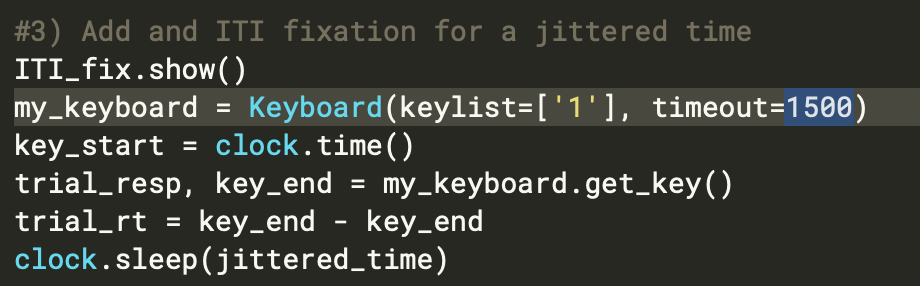
Could anyone advise on a strategy to gather responses within that 1.5-second window post-stimulus, while ensuring the ITI consistently adheres to the initial definition for each trial (defined by the variable jittered_time)?
Any help on this would be fantastic.
Cheers,
Patxi
Comments
HI Patxi,
Your code doesn't include how you compute the variable
jittered_timeCan you add that info?by the way, your
trial_rtvariable is computed the wrong way (not related to your question.Eduard
Hi Eduard,
Thanks for your quick reply! I believe I've resolved the issue by subtracting the response time from the jitter duration, ensuring the ITI remains unaltered by the response. It's currently working well, and the timing appears accurate, but I'm curious if there might be a more efficient or safer approach to achieve this. Your insights would be greatly appreciated.
Best,
Patxi
p.d.: jittered time is just a float
Hi Patxi,
A slightly more efficient approach would be this:
kb.flush()
start_time = ITI_fix.show()
k, t = kb.get_key()
if k is not None:
    trial_rt = t - start_time
clock.sleep(jittered_time - trial_rt)
With
kb = Keyboard(keylist=['1'], timeout=3500)being put before the loop (you only need to initialize it once, not on every trial). However, in practice the two versions would be almost identical.Eduard
Thank you so much Eduard! This code snippet works perfectly fine and it is definitely more elegant than my solution. In terms of timing there isn't any substantial difference.
Best,
Patxi