


Confused about "run if" formatting for sequences

I am coding a computer task where participants need to make a response across multiple trials. I want them to receive different feedback screens depending on whether they: a) respond correctly b) respond incorrectly or c) fail to respond in the calculated time window.
I'm a bit confused about formatting the "run if" statements, because I keep getting errors for using "=" instead of "==", but I thought "==" meant assigning a value to a variable. Everything runs fine with using "==", but I just don't understand what that means.
I also can't get the "time out" feedback to show at the right time. The script runs, but it only gives feedback for incorrect responses, and when the participant times out, it just moves straight into the next trial.
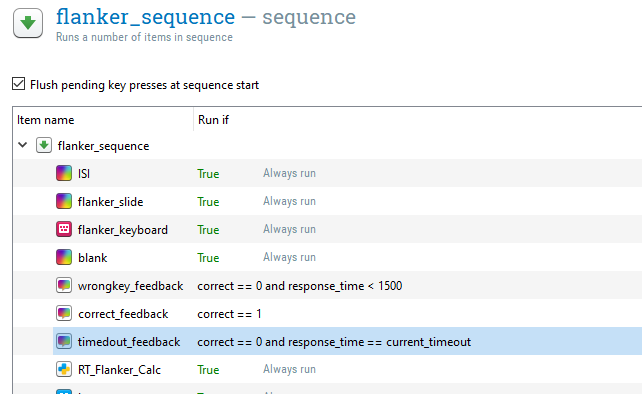
Any advice? I'm newer to using this software, so I'm still learning how to format things efficiently.
Comments
Hi @GeorgiaW,
Open Sesame runs on Python. In Python, "=" is used to allocate a value to a variable wheears "==" is used to test a variable against a specific value. So when using the "Run if", since you're testing a condition, you should use the "==".
As for displaying the feedback when participants respond too late, I believe it would work if you simply used the following "Run if " condition:
response == 'None'Best is to write a bit of code in an inline object to print the value response to the console and verify that this is indeed what the response's value is if the participant fails to respond anything. Note that the response time for non existing responses appears as whatever duration you set as the duration of your keyboard object. So in theory you could the method you're trying, but the actual response time can vary a little due to the jitter of the temporal resolution. So the method I'm suggesting is better.
Assuming that value of response in the absence of response is indeed "None", you should change the condition for the wrongkey_feedback to
correct == 0 and response != 'None'Give it a go and see if it helps.
Best,
Fabrice.
Hi Fabrice,
Thanks for your response and for explaining the Python formatting!
Your suggestion worked! Your method was more straightforward than what I was thinking, so I really appreciate it.
Best,
Georgia