


Different Degrees of Freedom (ANCOVA vs ANOVA)

Hi everyone! I am currently running the data analysis for my master thesis in JASP - first of all thank you so much for this great tool!
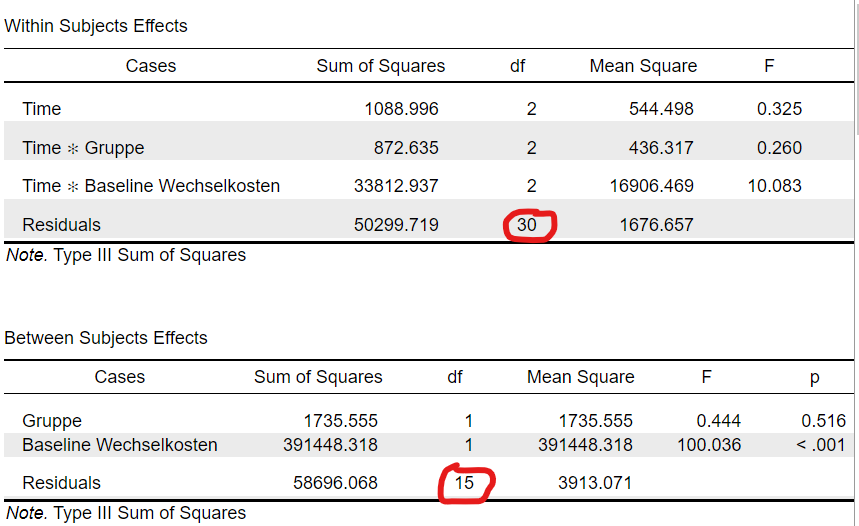
I have analysed the data of 18 participants who were in two different groups first with an ancova (with baselinedata of the dv as covariate) and then without the covariate in an anova.
I used the Repeated Measures function with the dv at the 3 different timepoints as within factor and group as between factor and put the baseline data in the covariate box.
When I wanted to report the results in APA-Style I noticed different degrees of freedom for the residuals between the ancova and the anova.
ANCOVA:
And ANOVA:
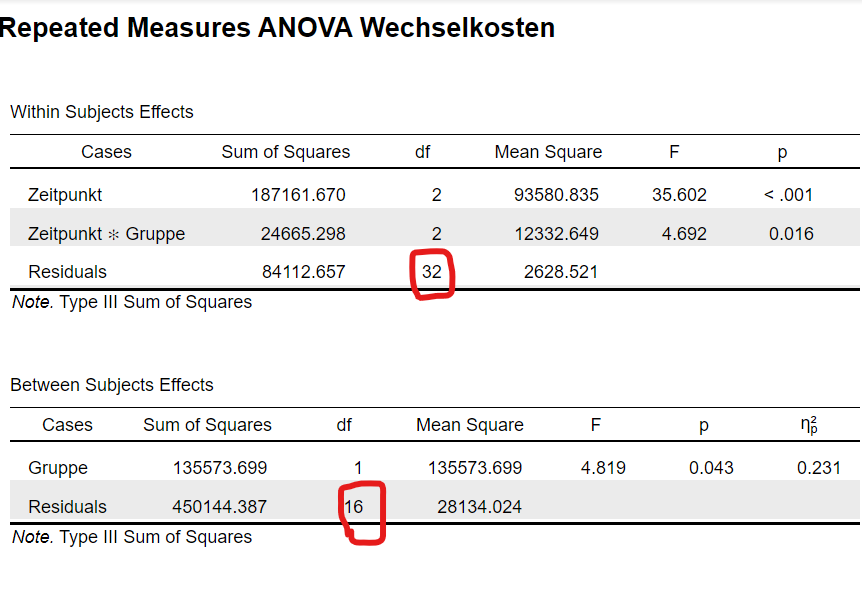
Are the degrees of freedom for the residuals correct for the number of participants (18) measurements (3) groups (2) and covariate (1)?
Does JASP/ one in general use different formulas to calculate the dfs - or does JASP automatically exclude outliers, because ANCOVA is sensitive to them?
Thanks for your help!!
Comments
Of course the difference in residuals is due to the difference between the models, i.e. the addition of baseline as a numeric predictor. Baseline as a predictor uses up 1 degree of freedom, and if it interacts with another predictor, it uses up another degree of freedom per interaction term.
The df calculations in JASP is identical to any other software or books. ANOVA and ANCOVA are ancient analyses (>100 years old).