


How to use JASP for subgroup analysis in meta-analysis

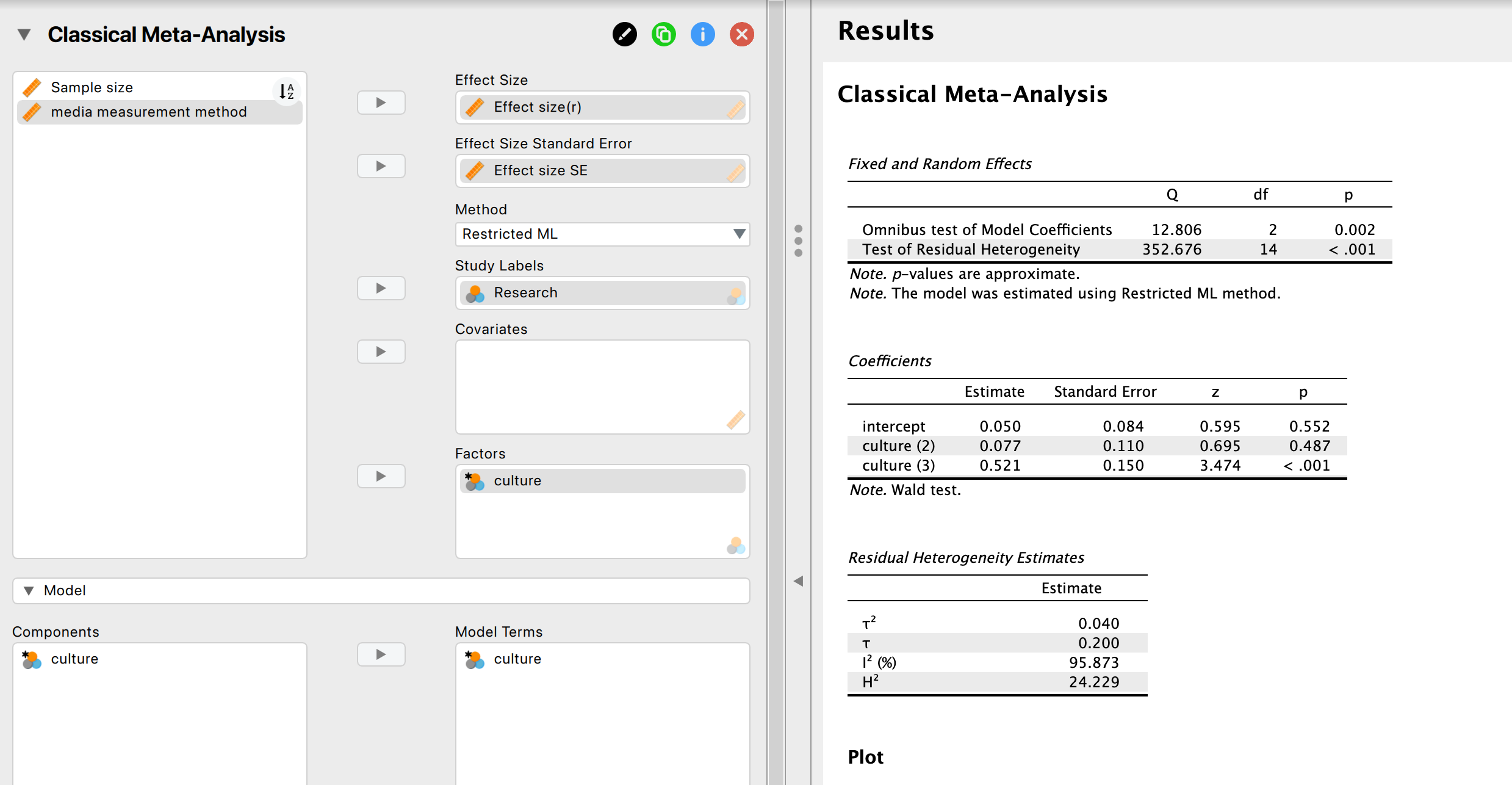
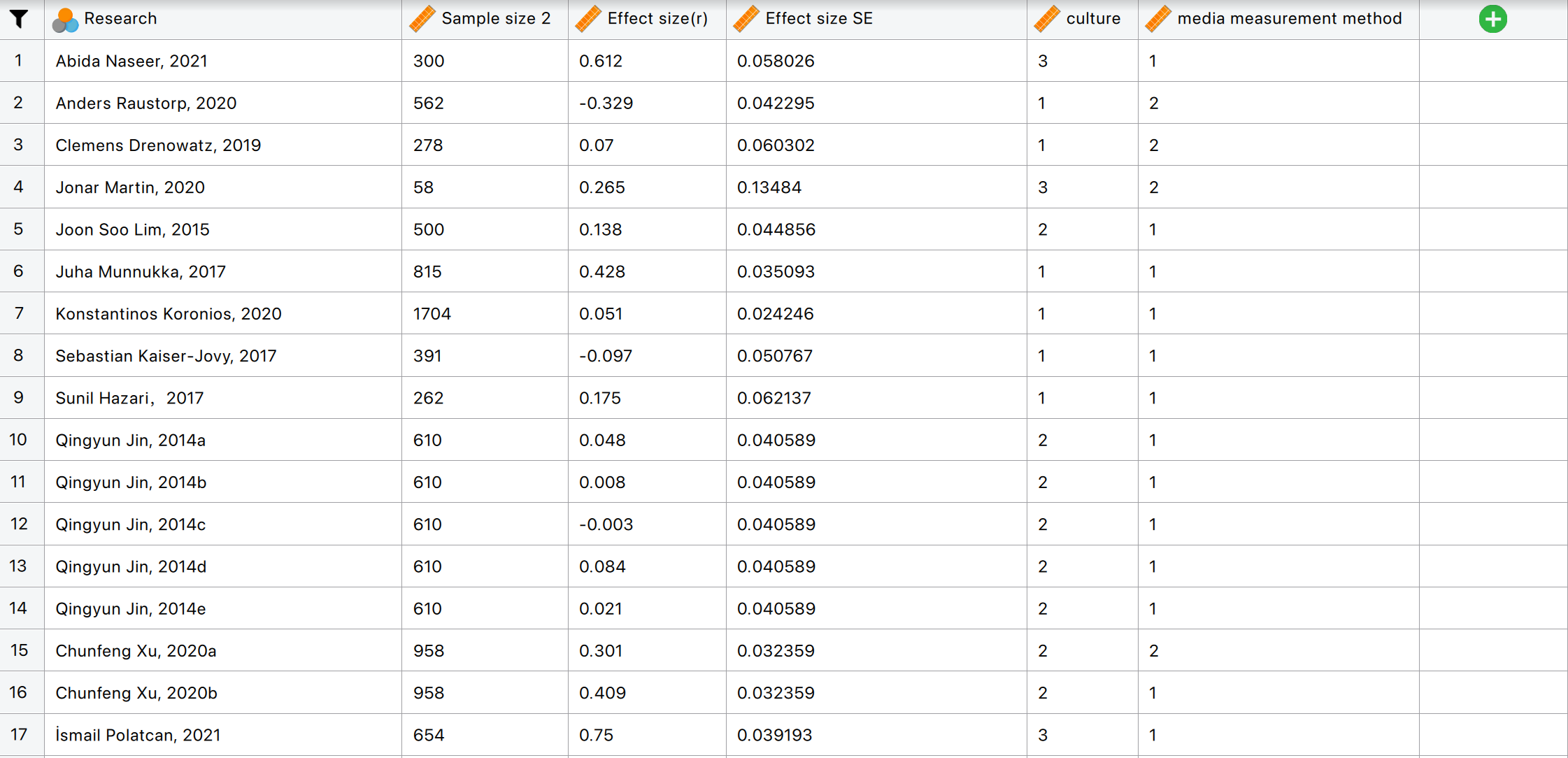
I am a doctoral student majoring in management. I am learning to use JASP for a meta-analysis. The main effects analysis section went very smoothly, but the subgroup analysis was a bit confusing for me. For example, my moderating variable "Culture" encodes 1, 2, and 3 (Figure 1). When I put "Culture" into "Factors", the result that appears is shown in Figure 2. Is the data that should be interpreted "coefficients"? However, this data is inconsistent with the results analyzed by previous researchers (which I obtained from a meta-analysis literature). Also, what does "intercept " mean?
I already spent several days trying to figure it out.I was hoping for it after searching on Google and YouTube. but still couldn't find the answer. It would be highly appreciated if you can give me an answer.Thanks for your help.
Comments
I'll ask the team
EJ
Hi barrychow,
What you see in the analysis is a meta-regression with the "culture" corresponding to a dummy-coded predictor. The intercept corresponds to the estimate in the level "1", and the coefficients "2" and "3" correspond to the difference from the level "1". These results might differ from the simpler subgroup analysis results since the meta-regression assumes a shared heterogeneity estimate (which is often a much more efficient model). The current version of meta-analysis does not allow a straightforward subgroup analysis (we are doing a big overhaul of the module for the next release later this year); however, you can take advantage of the "Filter" feature in JASP and proceed with an analysis on a filtered dataset (e.g. like this: https://jasp-stats.org/2018/06/27/how-to-filter-your-data-in-jasp/).
Cheers,
Frantisek
Dear Frantisek,
Are there any updates regarding this in the new version? I have a similar question, which is related to a test that I want to conduct to see if there are differences in 'strength' between categorical moderator. Taking the example of barrychow, I would like to test whether there are significant differences of culture 1 vs. culture 2, culture 2 vs. culture 3, culture 1 vs. culture 3 as moderators on the main effect.
Hopefully you can help me (& barrychow) out!
Cheers.
Hi happydad024,
We rolled out one part of the update in November: the options and output are much enhanced, but these pair-wise comparisons are still missing. Luckily, they were just recently added to the metafor package, and I'm planning to include them in the second part of the update.
As of now, the only suggestion I can offer is analyzing the data twice and changing the default factor level. Since the analysis uses dummy factor coding, you can inspect the meta-regression coefficients to obtain the pair-wise differences.
Cheers,
Frantisek