

Incongruency - Main effects vs Post Hoc comparisons

Hello,
I am using the last version of JASP and I am a bit confused by a result. Let's say I run a repeated measures ANOVA with a 2 level within-subject factor. This effect is not significant (Tone - See print screen). However, if I run within the same ANOVA a posthoc test on the main effect of Tone, I found a highly significant effect, while, If I am right, in theory I should find highly simi
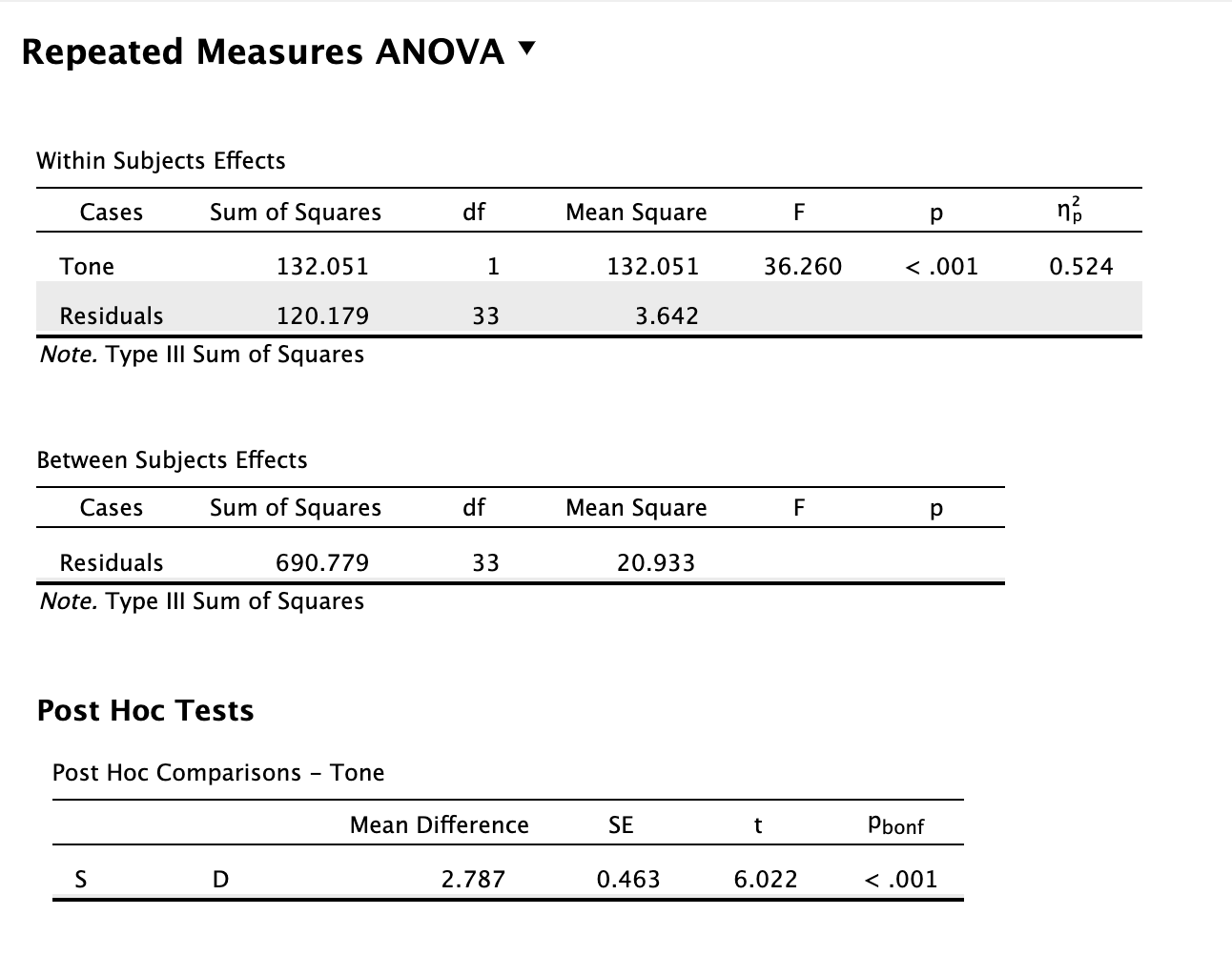
lar effects. If I remove the covariate, then results are more congruent, but it looks like the post hoc tests take into account the covariate since the values are changing. So I am not sure why the results are so different. The Bayesian post hoc seem to largely agrees with the frequentist post hoc (attached as well).
I have tried with 3 different results, and I always obtain the same "incongruency" between main effects and post hoc tests, at least when there is a covariate.
I was also wondering if there was a possibility to have the descriptives for contrasts or post hoc tests, because at the moment it only display a difference.
Thank you!
Comments
Hi. In your ANOVA, the effect of tone isn't non-significant. It's significant (p < .001). The posthoc test is also significant at p < .001. The F in your ANOVA is the square of the t in your t test. So the results agree exactly.
R
Oups sorry I put the wrong results. Here are two where the results are incongruent.
Probably, you would need to post your .jasp file to this thread.
R
I have here attached the JASP file and the associated .csv file. The results tab should load automatically. Here, I conduct the analyses on Generation 1 only, but I have the same issue with Generation =0 or =2.
You will also note the discrepancy with the bayesian version of the same analyses, where the effect Table and the Bayesian post hoc are in favor of H1.
Thank you for the help!
Hi.
Few things. First, this system has stopped notifying me of replies to my comments.
More importantly, I see couple of things that could turn out to be major problems. I'm am only going to talk out the non-Bayesian analyses.
(1) Generally, the inclusion of covariates complicates things quite bit. I've attched an altered version of you jasp file that includes a non-covariate version of the ANOVA. Without the covariate, the ANOVA and the post hoc test agree exactly.
(2) I used a similar program, jamovi, to analyze the same data (the jamovi file is attached)
. Again, without the covariate the ANOVA and the post-hoc test agree exactly. In contrast to jasp, when the covariate is included the agreement between the ANOVA and the post-hoc test is substantial though not 100%.
(3) Related to 2, I know that despite being labeled "Repeated Measures ANOVA," the analysis is something different--a Linear Mixed-Effects Model--which is not guaranteed to give the same result as a repeated-measures ANOVA. I think this MAY explain the radically different main effect of Tone (in the covariate-containing model) found by JASP versus jamovi.
Overall, I do agree that there's a concerning level of inconsistency between the ANOVA and the post-hocs for covariate-containing models. However, the inconsistency within JASP seems quite dramatic!
Finally, I know I'm not the only one who isn't getting notifications. I've tagged EJ on this @EJ , but I don't know if he'll be notified.
R
Hi @andersony3k ,
I took a look at your data files and comparison of the different programs - it seems in one you applied a filter and in one you did not, which leads to different results. Removing the filter leads to the same results, which are in line with a general approach to R (both softwares use R after all.
@EmilieC , I think the bottom line here is the same as in our other conversation: age and the interaction between age and tone seem to be playing a role here, which leads to different estimated marginal means compared to the marginal means within including age as a covariate. Both approaches can work, but they just have a different interpretation:
In the former, the marginal means are merely the descriptive means, in the latter, the marginal means are estimated quantities where we try to keep all other factors/covariates balanced, in order to provide a more balanced assessment of the tone difference.
Kind regards
Johnny
As an aside, I am not getting any notifications (I contacted Sebastiaan already)