


Standardized beta coefficients in Bayesian ANOVA/RM ANOVA/ANCOVA?

Hi everyone,
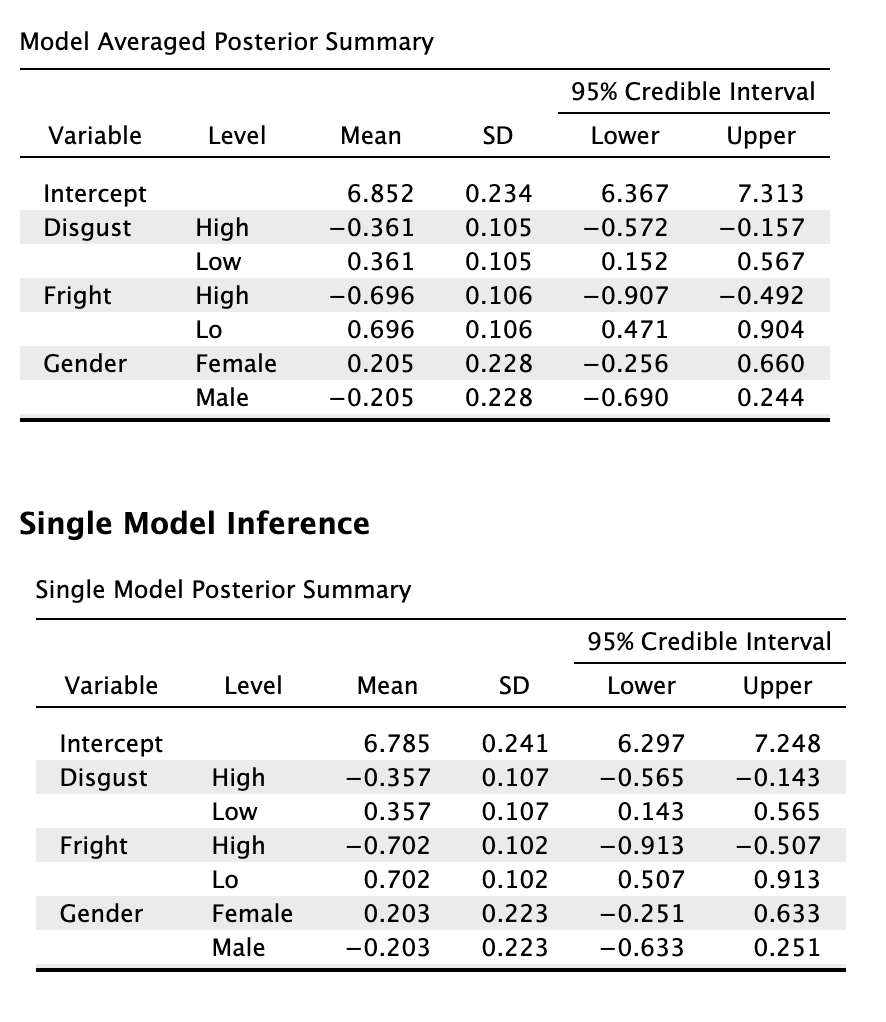
I just want to double check something. I took this previous post from linear regression to mean that in Bayesian ANOVA/RM ANOVA/ANCOVA (https://forum.cogsci.nl/discussion/7052/beta-values) that the "mean" in the posterior summaries with the 95%CI is the mean coefficient over the models. But then in Don van den Bergh's ANOVA tutorial, Table 4, these are referred to as the posterior distributions of each coefficient.
I've attached a sample output from the Bugs Disgust/Fright data set. My previous understanding was that the top table, "Model Averaged Posterior Summary" was the standardized beta coefficient of the respective measure averaged across all models, and the "single model inference" allowed me to specify e.g. my best model to obtain its standardized beta coefficients. So that I could infer that the influence of High Disgust (-0.357) was weaker than that of High Fright (-0.702) in the single model inference table.
Have I been misinterpreting the tables?
PS: I'm sorry if this is a silly question or anything.
Comments
These model-averaged posteriors are based on the single-model posteriors, weighted with each model's posterior probability. So you can think of it as first sampling a model (according to the posterior model probabilities) and then, conditional on the sampled individual model, drawing a sample from its coefficient. This model-parameter cycle of sampling is repeated many times, and the end-result is summarized in the table.
Cheers,
E.J.