

Problem with increasing presentation time of stimuli

Hi all,
For my EEG experiment, the timing of presentation of visual stimuli is crucial. They should be presented for 300 ms with a 200 ms blank inter-stimulus interval, so that the total duration is 500 ms.
The experiment is programmed in OS with psycho_legacy back-end. The code for stimulus presentation that we use is:
# preparation
my_canvas = Canvas() # stimulus
my_blankcanvas = Canvas() # ISI

for idx in stream_idx:
   # draw image
   my_canvas.image(exp.get_file(stim[idx])) # load png file
   timing_canvas[trial_idx] = my_canvas.show()
   eeg_trigger(1)
   self.sleep(295)

   # inter-stimulus interval
   my_blankcanvas.show()
   self.sleep(195)
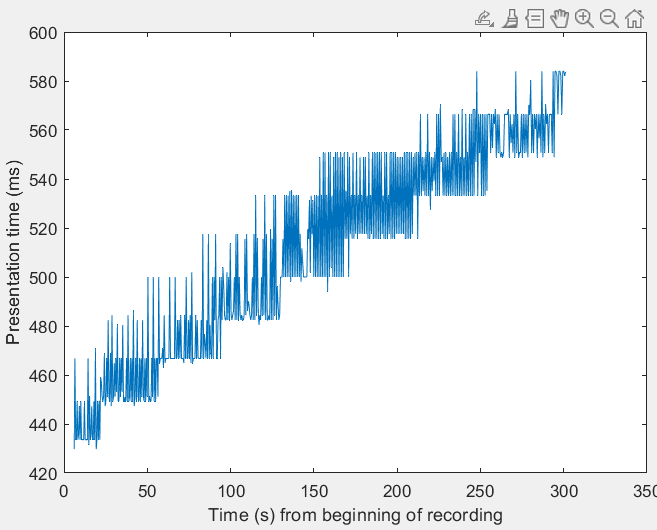
We send a trigger at the onset of a stimulus and calculate the difference between those onsets to get the duration between two consecutive stimuli.
The presentation time increases the further into the experiment (see figure below). There also seems to be a lot of variation regardless of the upwards trend. There exists a documentation page on timing (https://osdoc.cogsci.nl/3.3/manual/timing/) but I have not been able to fix the problem yet. I tried loading the images beforehand (in the preparation tab) but that did not seem to solve the issue.
Does anyone have an idea on how to solve this? It would be of great help! (I am new to OpenSesame, so this might be a simple change of code or back-end or ... that I am not aware of, or it might be a trigger related problem.)
Best,
Liesa
Comments
Hi @Lia@lrvts ,
There are two things going on here:
To solve this, I would first create a list of
Canvasobjects in the Prepare phase:my_canvases = [] my_blankcanvas = Canvas() for idx in stream_idx: my_canvas = Canvas() my_canvas.image(pool[stim[idx]]) my_canvases.append(my_canvas)And then show them in the Run phase:
for my_canvas in my_canvases:
    timing_canvas[trial_idx] = my_canvas.show()
    eeg_trigger(1)
    clock.sleep(295)
    my_blankcanvas.show()
    clock.sleep(195)
(I didn't test the code above, but it should convey the general idea.)
— Sebastiaan
Check out SigmundAI.eu for our OpenSesame AI assistant!
Dear Sebastiaan,
Thanks a lot for your answer! This indeed solved the (two) problem(s).
Best,
Liesa