AttributeError: 'Window' object has no attribute '_closed'

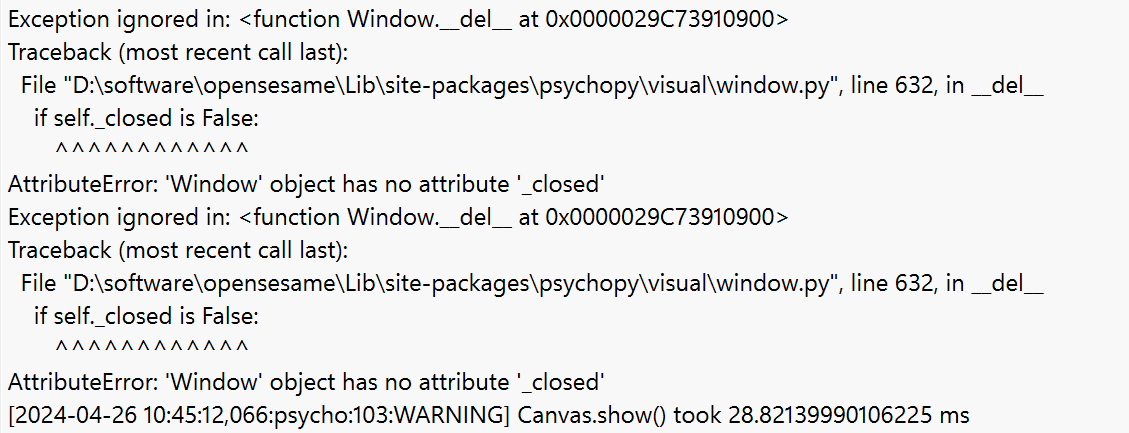
The experiment can run, but these errors and warnings have occurred, which may delay the process. How do I fix this? Help~

It looks like you're new here. If you want to get involved, click one of these buttons!

The experiment can run, but these errors and warnings have occurred, which may delay the process. How do I fix this? Help~
Comments
Hi @Ornella ,
This seems like a bug in PsychoPy, and I suspect you're using an older version of OpenSesame (bundled with an older version of PsychoPy). Is that correct? If so, then I would update to the latest version of OpenSesame.
Also, I don't think the error itself is necessarily a problem, because I suspect it occurs at the very end when the experiment closes, right?
— Sebastiaan
Check out SigmundAI.eu for our OpenSesame AI assistant!
Hi @sebastiaan,
I have updated the version of OpenSesame. It works! Thank you very much!☺️😀
Hi, I am getting the same error, but with opensesame 4.0.32 and psychopy 2024.2.5.
fyi I am trying to run an experiment where for speed reasons the canvases are drawn and stored in advance, and I get this error for every single canvas drawn, i.e. thousands of times per trial, so it kills the functionality of the experiment.
@jevrihanna Can you post the code that you use to create the canvases and the exact error message that you get?
Check out SigmundAI.eu for our OpenSesame AI assistant!
Hi @sebastiaan, the code is as follows. First a template canvas is created:
# setup canvas and stimuli
canvas = Canvas(color="gray")
fix_pos = (0, ang2pix(7))
fix_symb = "F" if follow else "S"
canvas["fix"] = Text(fix_symb, x=fix_pos[0], y=fix_pos[1], color="black", font_size=72, font_bold=True)
circle_kwargs = {"color":"black", "penwidth":14}

# need to get the image size
canvas["image"] = Image(pool[filename])
image_size = canvas["image"].size
circle_size = max(image_size)/2
circle_size -= int(round(circle_size * circle_reduction))
del canvas["image"]
canvas["circle"] = Circle(0, 0, circle_size, **circle_kwargs)
canvas["fix_circle"] = Circle(0, 0, circle_size, **circle_kwargs)

# instructions
instr_str = follow_str if follow else fix_str
if practice:
    canvas["instructions"] = Text(f"{instr_str}\n\nFirst, keep your focus on the {fix_symb} below.", y=-ang2pix(6), color="black", font_size=48)

# get basic parameters calculated
img_width = image_size[0]
left_point = -1 * (width // 2) - img_width // 2 - circle_kwargs["penwidth"]
right_point = (width // 2) + img_width // 2 + circle_kwargs["penwidth"]
sleep_time = 1#1000 / mon_refresh - 5

# get the x coordinates
cur_x = 0.
x_frames = []

# left to centre
while cur_x > left_point:
    x_frames.append(cur_x)
    cur_x -= pix_per_frame
# flip the order to make it left to centre
x_frames = x_frames[::-1]
# centre to right
cur_x = 0.
while cur_x < right_point:
    cur_x += pix_per_frame
    x_frames.append(cur_x)
# flip if right to left
if not left:
    x_frames = x_frames[::-1]
canvas["circle"].x = x_frames[0]

# block/trial info
cur_trial += 1
cur_block = (cur_trial // block_size) + 1
print(f"{cur_trial} {cur_block}")
Then we wait for eyetracker fixation:
canvas.show()
# wait for eyes to fixate for a certain period of time, and recalibrate if necessary
if not wait_for_gaze(fix_pos, 2500, tolerance=32, gaze_timeout=10000):
    send_triggers(3,'Recalibration start')
    eyetracker.calibrate()
    eyetracker.start_recording()
    send_triggers(4,'Recalibration end')
    items.run(u"fixate")

if practice:
    del canvas["instructions"]
# replace instructional symbol with +
del canvas["fix"]
canvas["fix"] = Text("+", x=fix_pos[0], y=fix_pos[1], color="black", font_size=48, font_bold=True)
canvas.show()
# jittered delay
clock.sleep(random.randint(jitt_low, jitt_high))
Then the canvas is iteratively copied with small translational changes to one object
This error message is repeated 100s of times: